The defence alliance NATO has launched Operation Arctic Sentry on 11 February. Officially meant to “leverage NATO’s strength to protect the alliance’s territory in the Arctic and High North”, it is meant not only to discourage Russia and China of making advances. It is also aimed to keep US president Trump’s political and military pressure to take Greenland at bay.
However, Arctic Sentry is more than just a military umbrella for Greenland. All of NATO’s operations and exercises in the Arctic and sub-Arctic regions are to become part of Arctic Sentry. This includes the Greenland protection operation Arctic Endurance launched by Denmark, to which semi-autonomous Greenland belongs, as well as Norway’s regular Cold Response exercise that involved loads of NATO units simulating war in winter conditions.
Swedish fighter jets to Greenland
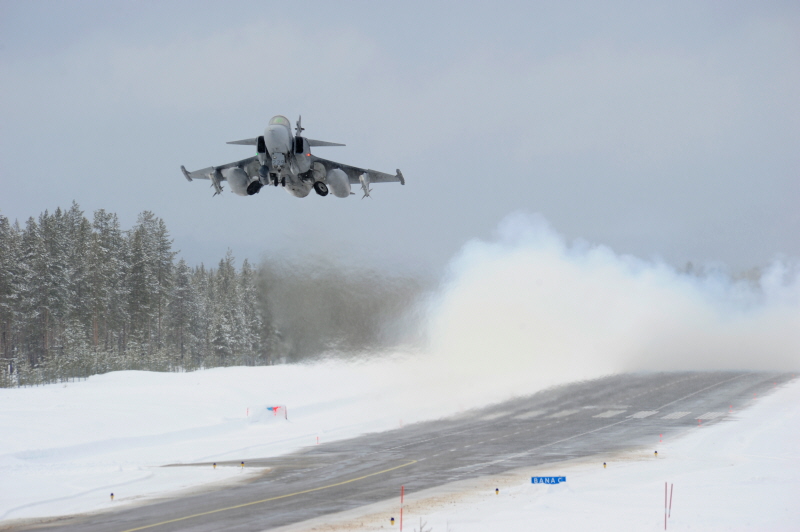
The alliance’s youngest member, Sweden, was quick in stating that initially Swedish Air Force SAAB JAS 39 Gripen fighter jets will be part of Arctic Sentry — with air policing and armed reconnaissance missions envisaged over Iceland and Greenland. Six Gripen aircraft are to pick up NATO’s rotating air defence operation from Keflavik Airbase in Iceland. Swedish media report that the two of them are likely to be tasked with protecting the skies over Greenland.
British-led Expeditionary Force
The British-led Joint Expeditionary Force (JEF) for NATO’s far north will also be part of Arctic Sentry and includes also military units from Denmark, Estonia, Finland, Latvia, Lithuania, the Netherlands, Norway and Sweden. London has also said it is planning to double its military ground forces contribution for Northern Norway from 1,000 now to 2,000 in the next three years — with the Royal Marines as the core of this force. | © 2026 Marcel Burger, nordicreporter.com. Featured image: JAS 39 Gripen during a winter exercise, on short takeoff. Photo: Louise Levin/Försvarsmakten